
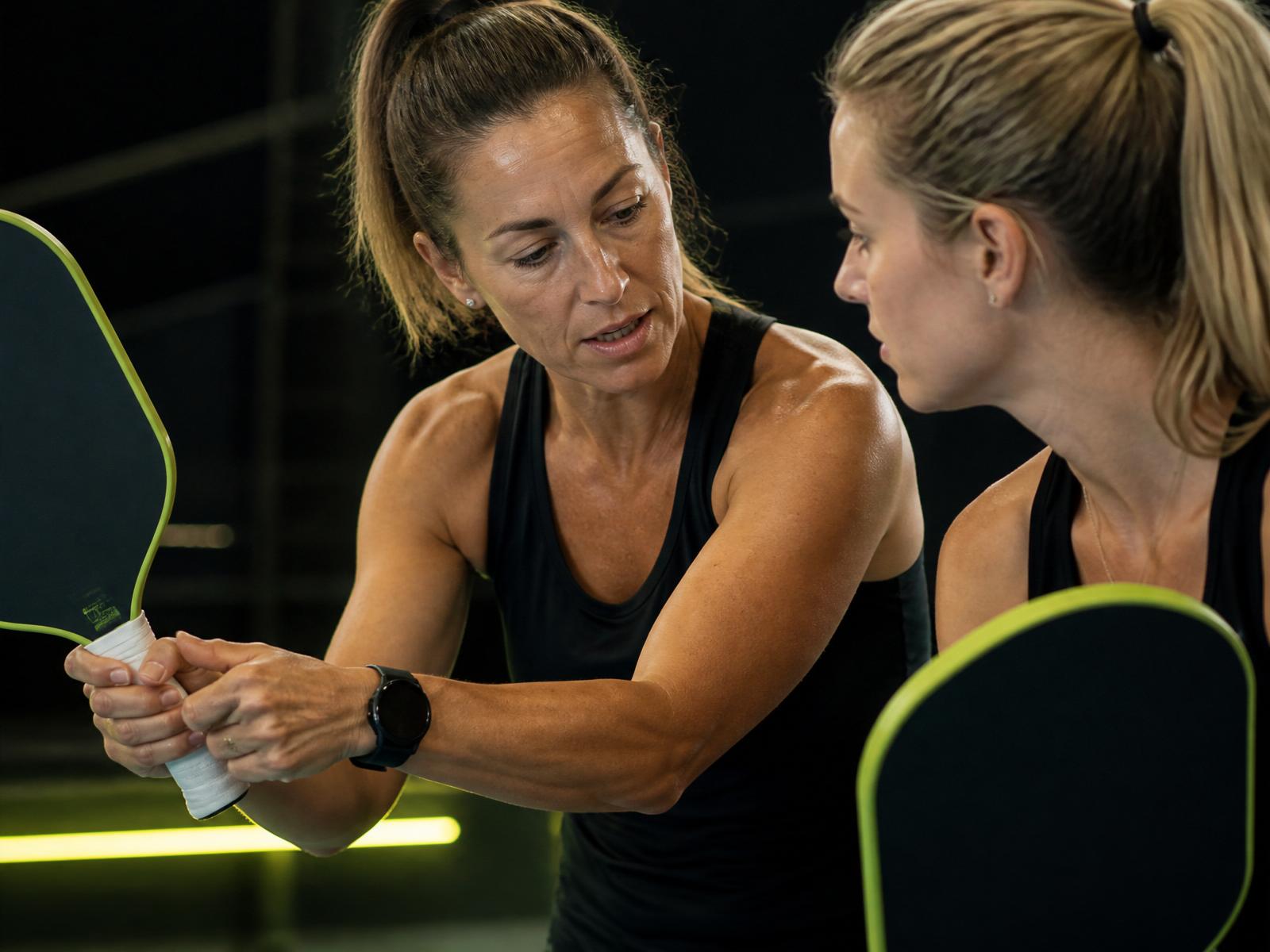
Players moving through a footwork drill
Pillar 02: Fitness

Fitness.

Good technique disappears the moment you are off balance or out of position. Fitness in pickleball is not gym work — it is footwork, recovery between shots, and still moving properly in game nine.

The building blocks

What we teach.

  • The split step — timing it to your opponent's contact, not your own
  • Lateral movement and shuffle patterns, so you stay square instead of reaching
  • Getting through the transition zone in a controlled way rather than sprinting into the kitchen
  • Balance and recovery: hitting, resetting your base, and being ready for the next ball
  • Reaction speed at the kitchen line — hands drills for the fast exchanges
  • Warm-ups, calf and shoulder care, and the injury patterns we see most in returning athletes
  • Endurance for long sessions and multi-round tournament days
Players moving through a footwork drill
The progression

How we build it.

01

Start with the warm-up

Every session opens with the same movement prep. It is short, it is boring, and it is why most of our players stay on court.

02

Movement before intensity

We fix the pattern at walking pace first. Speeding up a bad movement just gets you to the wrong place faster.

03

Add pressure

Feed drills get quicker, the space gets tighter, and the drill becomes a live point. That is where reaction speed is actually built.

04

Build the tank

Longer rotations and back-to-back games so your last game of the night looks like your first.

The programme

The fitness block, drill by drill.

Pickleball fitness is short, sharp and lateral. Nobody needs a marathon base — you need to change direction, split-step on time, and still be moving properly in game three. Everything here fits either side of a normal session.

Six movement and conditioning drills

01

Split-step timing

Being loaded and ready the moment the ball is struck

Set-up
Partner feeds from across the net at random intervals; you shadow at the line.
Reps
3 rounds of 60 seconds, 60 seconds rest.
Coaching point
Land the split-step as their paddle meets the ball, not after. Small hop, wide base, weight on the balls of your feet.
02

Kitchen-line shuffle

Lateral speed without crossing your feet

Set-up
Cones at each sideline, along the kitchen line.
Reps
6 lengths, 30 seconds rest, 4 sets.
Coaching point
Paddle up the whole time. Shoulders square to the net — the second you turn and run you have lost the next ball.
03

Figure-eight court sprints

Forward and back transitions under fatigue

Set-up
Baseline to kitchen line, touch, back to baseline, diagonally across, repeat.
Reps
4 laps, 45 seconds rest, 4 sets.
Coaching point
Decelerate with short choppy steps rather than one big lunge — this is where knees and ankles get hurt.
04

Shoulder and wrist prep

Keeping the paddle arm healthy

Set-up
Light resistance band on a fence post.
Reps
External rotations 2×15 each arm, band pull-aparts 2×15, wrist circles 30 seconds.
Coaching point
Do this before you play, not after. Most pickleball elbow starts as a cold shoulder and a tight forearm.
05

Legs for the low game

Holding a low, athletic dinking posture

Set-up
Wall or bench court-side.
Reps
Wall sit 3×45 seconds, step-ups 3×10 each leg, split squats 3×8 each leg.
Coaching point
If you are bending at the waist to dink, this is the fix. Height comes from the knees.
06

Game-three intervals

Repeat-effort endurance

Set-up
Play out points of 8–12 shots with a strict 15-second gap between rallies.
Reps
10 rallies, 3 minutes rest, 2 sets.
Coaching point
The aim is to be making the same decisions on rally ten as on rally one. When shot choice goes, stop the set.

Session templates

Match-day warm-up — 12 minutes

Before every competitive session

  1. 13 min easy movement: shuffles, skips, arm swings.
  2. 22 min band work: external rotations and pull-aparts.
  3. 33 min dinking, gradually lengthening.
  4. 42 min drives and returns at 70 percent.
  5. 52 min serves and one full rally at match pace.

Cool-down — 6 minutes

Straight after you come off court

  1. 12 min easy walking while your heart rate drops.
  2. 2Calves, hip flexors and forearms — 30 seconds each side.
  3. 3Two minutes of nasal breathing before you get in the car.

Weekly load template

For anyone playing three or more times a week

  1. 1Two hard sessions — ladder night and one drilling hour.
  2. 2One social or open-play session at easy intensity.
  3. 3One short strength session: legs, shoulders, core.
  4. 4One full day off court every week, no exceptions.
On the timetable

Where you'll see it.

Questions

Before you ask.

Do I need to be fit to start?

No. The court is a quarter the size of a tennis court. People play well into their seventies — the point of this pillar is keeping you playing, not filtering anyone out.

Is this gym training?

No. It is on-court movement, footwork and injury prevention. Anything you do in a gym is your business.

I have a dodgy knee or shoulder. Can you work around it?

Yes. Tell us before the session and we adjust the drills and the warm-up.

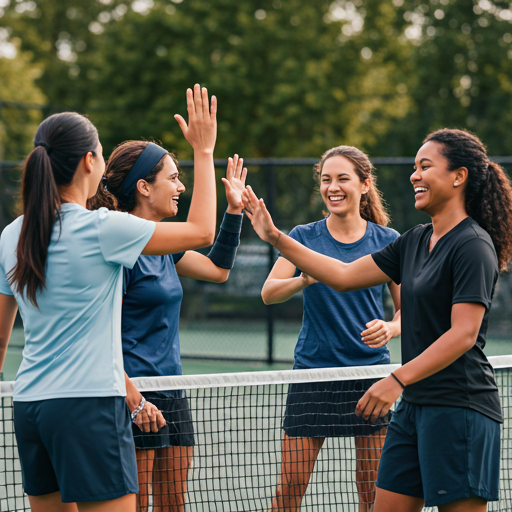
Players high-fiving after a community session
The reason anyone stays
Pillar 03: Fun

Every pillar runs through our lessons, terms and events.

Technique to build it, fitness to hold it, fun to keep you here, competition to test it. Every session we plan draws on all four.