
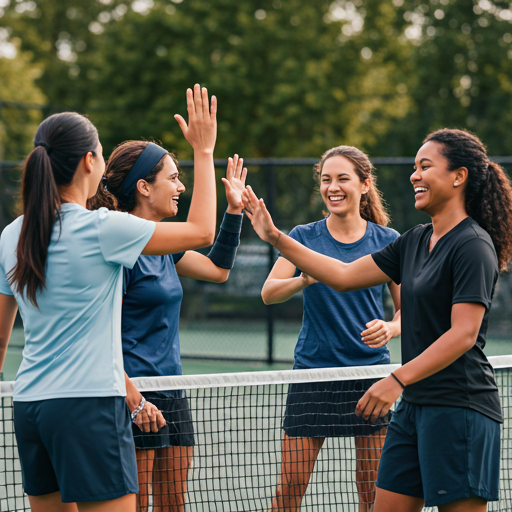
Players high-fiving after a community session
Pillar 03: Fun

Fun.

Nobody improves at a sport they dread turning up to. Fun is not the soft pillar — it is the one that keeps you on court often enough for the other three to work.

The building blocks

What we teach.

  • Rotating doubles, so you play with four or five different people in a night
  • Mixed-level rotations that put newer players on court with better ones on purpose
  • Club nights and socials — pickleball first, then everyone stands around talking about it
  • Mixers and themed nights that break up the same-four-people habit
  • How to run a friendly game: calling lines honestly, paddle taps, keeping the queue moving
  • The culture we insist on — nobody is made to feel new, nobody is made to feel slow
Players high-fiving after a community session
The progression

How we build it.

01

You are playing within ten minutes

No drills queue on a social night. Five minutes on serve, kitchen line and scoring, then you are in a real game.

02

Rotations, not cliques

Partners and courts rotate on a system. It is the single biggest reason new players come back.

03

Somebody is always looking after the room

There is a host on every session whose job is to make sure nobody is standing on the side wondering what to do.

04

It carries on off court

The WhatsApp group is where the pickup games actually get organised. Members get the link.

The programme

Games and formats we run.

Fun is a programme, not an accident. These are the games we use to keep a session moving, mix the levels up and send everyone home wanting the next one. Steal them for your own club night.

Six games worth running

01

Skinny singles

Accuracy and patience with nowhere to hide

Set-up
One half of the court only, diagonal or straight, one player each side.
Reps
First to 11, win by 2. Loser rotates off.
Coaching point
The court is narrow, so shot selection matters more than power. Great leveller between a strong and a weaker player.

02

Dink to eleven

Soft game under real scoring pressure

Set-up
Full doubles, but any ball hit above shoulder height loses the point.
Reps
Game to 11.
Coaching point
Watch how quickly people discover cross-court is the safe dink and down-the-line is the risky one.
03

Champ court

Rotation that keeps every court competitive

Set-up
Four courts, court one is the champ court. Winners move up, losers move down.
Reps
Games to 7, rotate on the horn every seven minutes.
Coaching point
Split the winning pair when they move up. It stops one dominant partnership sitting on court one all night.
04

Blind-draw doubles

Mixing levels and meeting people

Set-up
Everyone's name in a hat, redrawn every round.
Reps
Four rounds of 12 minutes, running score per player.
Coaching point
The best format for a new player's first night — they get three different partners who all say hello.
05

Target buckets

A skills game for the last ten minutes

Set-up
Buckets in the kitchen and at the baseline corners.
Reps
Five serves and five third-shot drops each. Highest score buys the coffees.
Coaching point
Competition makes people concentrate on technique in a way that a plain drill never will.
06

Around the world

A warm-up that gets everyone laughing

Set-up
Everyone lines up behind the baselines, hit and run to the back of the other line.
Reps
Lose a life on an error, three lives each.
Coaching point
Run it first thing. It gets bodies warm and breaks up the cliques before the real games start.

Run-sheet templates

Club social night — 90 minutes

A mixed-level open night

  1. 10–10 min: around the world warm-up, names and hellos.
  2. 210–20 min: dink to eleven, fixed pairs.
  3. 320–70 min: blind-draw doubles, four rounds, rotate every 12 minutes.
  4. 470–85 min: champ court for whoever wants it, target buckets for whoever doesn't.
  5. 585–90 min: notices, next week's session, everyone off court together.

Bring-a-mate first-timers hour

New players, never held a paddle

  1. 110 min: grip, ready position, one dink each.
  2. 215 min: serve and return, no scoring.
  3. 310 min: the kitchen rule, explained on court rather than on a whiteboard.
  4. 420 min: skinny singles and short games to 5.
  5. 55 min: what's on this week, and how to come back.

Ladder night format

Weekly, for players who want a result

  1. 1Seed off last week's ladder positions.
  2. 2Champ court rotation, games to 7, seven-minute rounds.
  3. 3Split winning pairs on every promotion.
  4. 4Post the ladder the same night — that is the bit people come back for.
On the timetable

Where you'll see it.

Questions

Before you ask.

Will I be out of my depth?

Rotating doubles means you get a spread of partners and opponents. Nobody plays four straight games against the best pair in the room.

Do I need to bring a partner?

No. Nearly everybody arrives alone the first time.

Do I have to commit to a night every week?

No. Turn up when you can.

Competitive tournament play under lights
Ready to test it?
Pillar 04: Compete

Every pillar runs through our lessons, terms and events.

Technique to build it, fitness to hold it, fun to keep you here, competition to test it. Every session we plan draws on all four.