
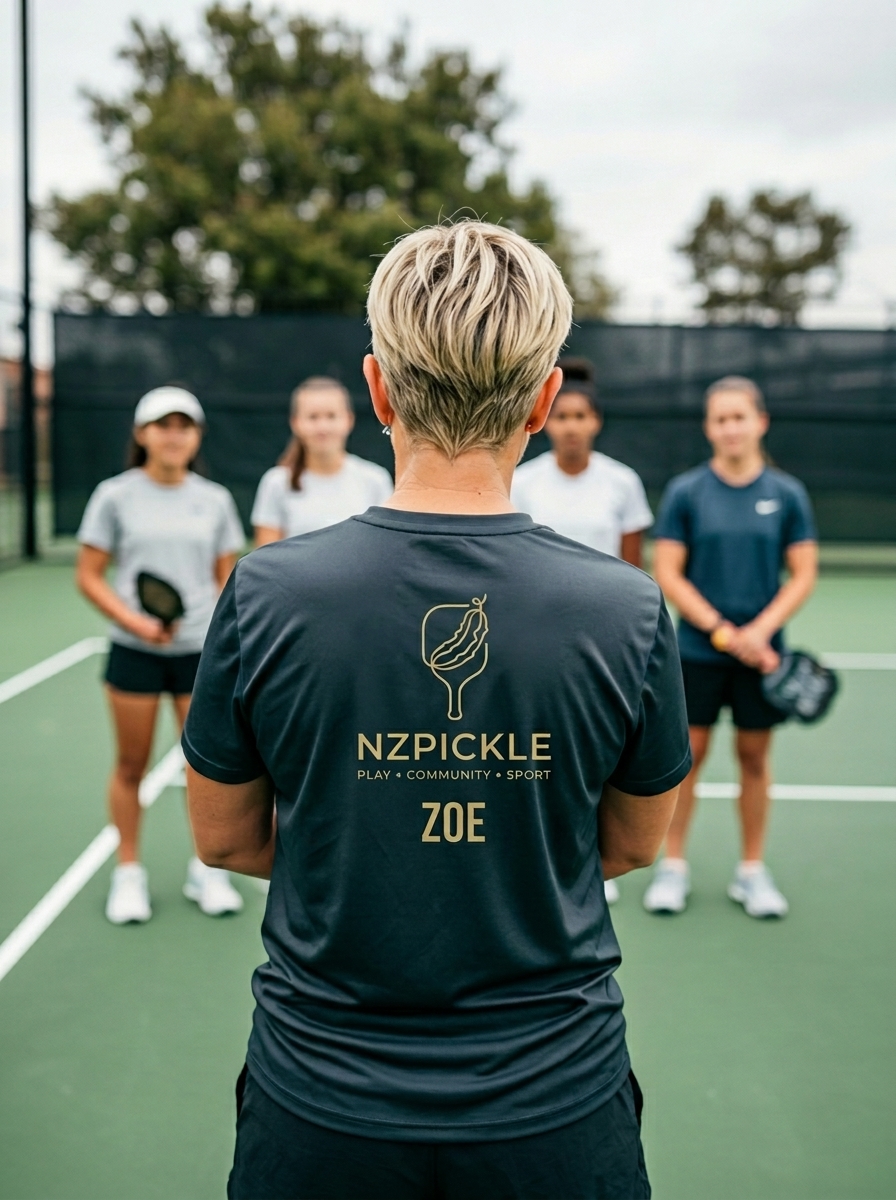
Coach Zoe demonstrating a dink at the kitchen line
Pillar 01: Technique

Technique.

Most players are not losing points because they lack talent. They are losing them because the grip is wrong, the paddle is late, or they have never been shown what a reset actually is. Technique is where every NZPickle programme starts.

The building blocks

What we teach.

  • Continental grip, paddle face control and a ready position you can actually hold
  • Serve and return depth — the two shots that decide who gets to the kitchen first
  • Dinks: push versus lift, cross-court as your resting shot, height over the lowest part of the net
  • Resets out of the transition zone, so a hard drive at your feet stops being a lost point
  • The third shot drop and the third shot drive — and knowing which one the situation is asking for
  • Kitchen-line positioning, paddle-up defence and moving as a pair rather than two singles players
Coach Zoe demonstrating a dink at the kitchen line
The progression

How we build it.

01

Assess what you actually do

We watch you play a few points before we change anything. Nine times out of ten the fix is one thing, not ten.

02

One block at a time

Grip and contact before dinks. Dinks before resets. Resets before the third shot drop. Skipping ahead is why people plateau.

03

Drill, then play it live

Every technical block finishes with a game constraint that forces you to use it, so it survives contact with a real opponent.

04

It stays on your record

Your assessment, the shot we are working on and where you got to are kept on your member record, so the next session picks up where the last one stopped.

The programme

Drills we actually run.

This is the technique block, in the order we teach it. Every drill below is run in our lessons and terms — take them to your own practice hour and they will still work. Two players, a bucket of balls, forty minutes.

Six technique drills

01

Cross-court dink ladder

Consistency and height control in the soft game

Set-up
Both players at the kitchen line, diagonally opposite. Dink cross-court only, forehand to forehand.
Reps
Get to 20 in a row, then 30, then 40. Restart the count on any error.
Coaching point
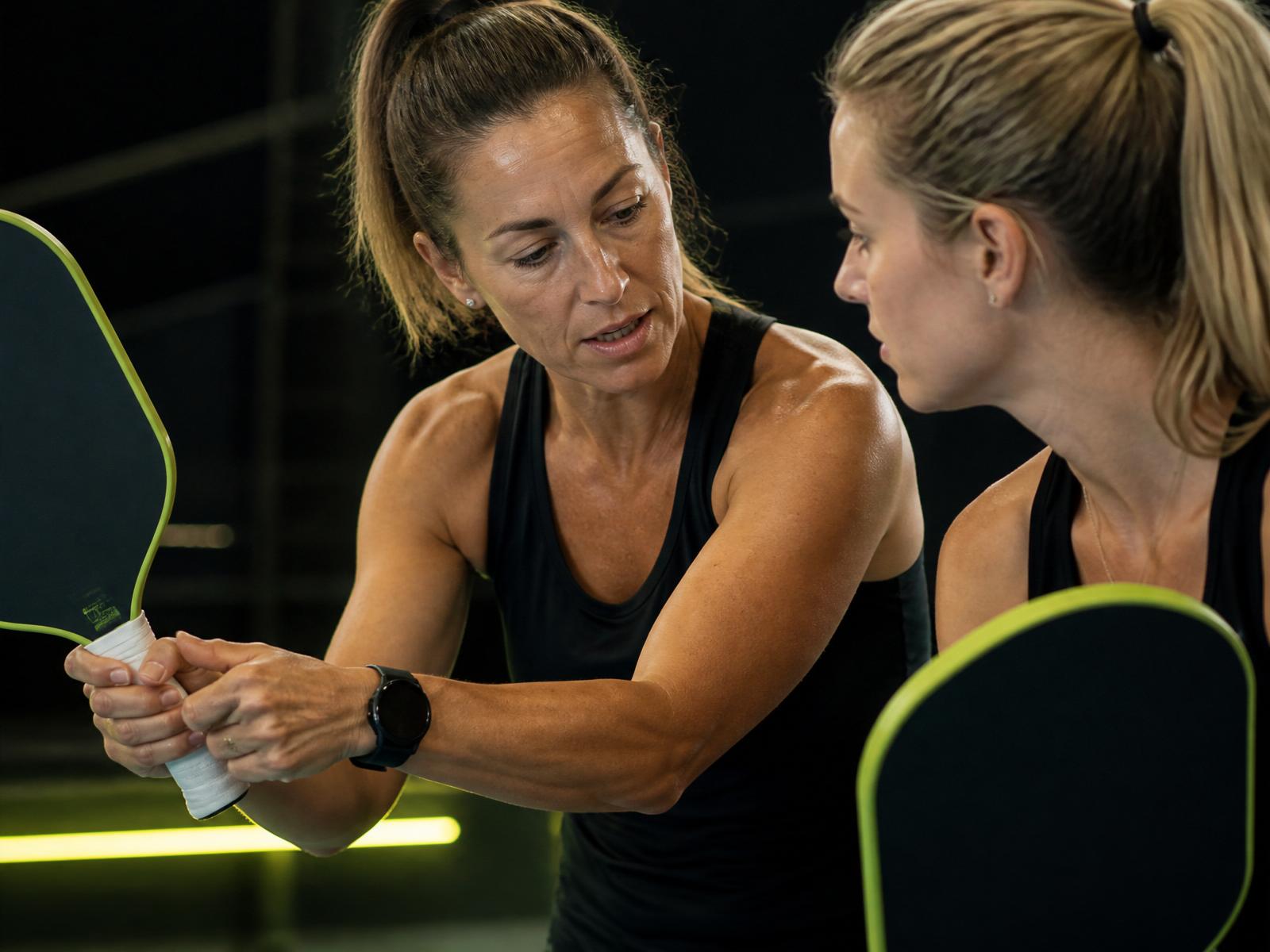
Contact out in front and below the wrist. If the ball is popping up, your paddle face is opening at contact — push, do not lift.
02

Transition-zone resets

Absorbing pace on the way to the net

Set-up
One player feeds medium drives from the baseline. The other starts mid-court, two steps behind the kitchen line.
Reps
10 resets, then step in one pace and repeat. Three rounds each.
Coaching point
Split-step before the feed lands, then stop moving. Loose grip — three out of ten in the hand — and let the paddle give.
03

Third shot drop ladder

The shot that gets you to the kitchen line

Set-up
Feeder at the kitchen line, dropper at the baseline. Feeder returns every ball deep.
Reps
7 drops in a row that land in the kitchen. Miss one, back to zero.
Coaching point
Lift from the shoulder, not the wrist. Aim two feet above the net and the top of the kitchen line, not the net cord.
04

Hands battle

Speed-ups, blocks and counter-attacks at the line

Set-up
Both players at the kitchen line, one metre apart on the diagonal.
Reps
First to 7 points. Rally must start with three dinks before anyone can speed up.
Coaching point
Paddle tip up and in front of your chest between shots. Counter with a block, not a swing — the ball already has pace.
05

Serve depth targets

Deep, repeatable serves under a scoreline

Set-up
Lay two towels across the back third of the service box.
Reps
20 serves. Score 2 for a towel, 1 for the back third, minus 1 for a fault.
Coaching point
Same ball drop, same contact height, every time. Depth beats power — a deep serve keeps them off the kitchen line.
06

Return deep and come in

Joining the return with the move forward

Set-up
Feeder serves. Returner returns deep and closes to the kitchen line.
Reps
15 returns. Only count the ones where both feet are set at the line before the third shot lands.
Coaching point
Take the return early and drive through the ball — your forward momentum is the point of the shot.

Game-plan templates

Against a banger

The other team drives everything and never dinks

  1. 1Return deep and high — take away the low, fast ball they want.
  2. 2Block, do not swing. Soft hands off the drive, ball dies in the kitchen.
  3. 3Once they are stuck at the baseline, dink cross-court and make them come forward.
  4. 4Expect one big drive per rally and be set for it, paddle up.

Against two patient dinkers

Both opponents live at the kitchen line and never miss

  1. 1Win the middle — most patient teams have a soft seam between them.
  2. 2Change the height, not the speed: a heavier cross-court dink forces a lift.
  3. 3Take the first ball above net height. That is the point, do not wait for a better one.
  4. 4Move as a pair — if your partner is pulled wide, you shift with them.

Your first five shots

Every single rally you serve

  1. 1Serve deep to the backhand.
  2. 2Recover behind the baseline, split-step as they hit.
  3. 3Third shot: drop if the return is deep, drive if it is short.
  4. 4Move in behind the drop and reset anything at your feet.
  5. 5Arrive at the kitchen line, paddle up, and start the soft game.
On the timetable

Where you'll see it.

Questions

Before you ask.

I have played for a year. Is technique work still for me?

Especially then. Year-one players usually have a serviceable rally and no reset. That one gap is what keeps the same people beating you.

Will you change my grip?

Only if it is costing you. We would rather fix contact point and paddle angle than rebuild something that already works.

Private or small group for technique?

Private if you know the problem. Small group if you want the whole toolkit built in sequence.

Players moving through a footwork drill
The body that plays the shots
Pillar 02: Fitness

Every pillar runs through our lessons, terms and events.

Technique to build it, fitness to hold it, fun to keep you here, competition to test it. Every session we plan draws on all four.